


Death of two stock exchanges in Pakistan

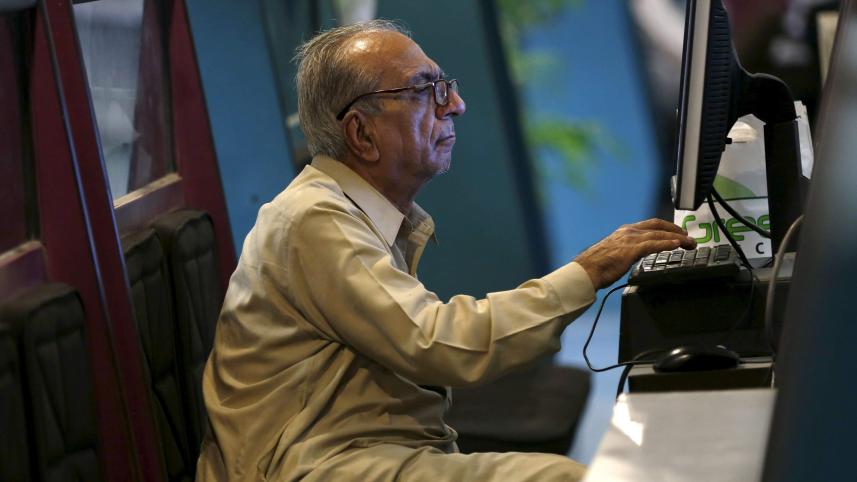
JANUARY 11, 2016 will remain an important date for business historians, for the unnatural death of Lahore and Islamabad stock exchanges in Pakistan. The country integrated all three of its bourses -- Karachi, Lahore and Islamabad -- on the day, in the 'second phase towards the implementation of the Corporatisation, Demutualisation and Integration Act 2012'.
The Karachi Stock Exchange building has changed its signboard prominently: Pakistan Stock Exchange, and the new symbol of the benchmark indices will be PSX.
 For all latest news, follow The Daily Star's Google News channel.
 Pakistan has never been a role model for any country or economy. The country is known to be in a chaotic law and order situation, economic instability and a confused culture. This negative image is held both in the east and the west. It has also been relegated from the list of emerging markets despite being in the N-11 in 2005, and the government is overtly tackling the 4 Es: economy, extremism, energy and education.
Thinking of the economy, Pakistan has every reason to be desperate to redress the playing field for investors, as not only foreign financiers, but a vast number of Pakistani investors have been uncomfortable in investing in the country for fear of the situation around the 4 Es.
A plan to bring a change in the capital market had to be drastic in Pakistan, though the implementation process took more than a decade.
The slogan for “Oneness” had to be political, and the “Power of One” has apparently won at this stage. Certainly, the government led the change showing a strong political will to bring in positive changes and give the world a signal that the corporate governance in Pakistan has leapfrogged.
And certainly it is not the Securities and Exchange Commission of Pakistan (SECP) alone, rather the Competition Commission of Pakistan (CCP) also played a crucial role.
According to the CCP, the integration of the bourses was to remedy certain competition concerns, for which the CCP helped the SECP actively. The two commissions worked hard, really hard, as bitterness among the wealthy and powerful stockbroker community loomed.
Competition, after all, is good for the front runners, and the forerunners in capitalism are naturally wealthy and powerful. While Karachi, in general, minded two smaller exchanges as nought, Islamabad and Lahore feared the swallow of a big fish.
SECP, after a long battle, decided to cancel the registration of two exchanges and offer trading rights for all of their brokers in a collective manner. Every stockbroker of Pakistan is thus therefore 'absorbed'.
“United we stand” is the endnote of many moral stories. In the case of the integration of Pakistan Stock Exchanges, the list of reasons of the unification is pretty long. In the opinion of the SECP, the integration complies with the international and regional trend, and consolidation will bolster the financial health of the stock exchange. Investors' protection fund too will be enlarged, boosting their confidence.
Also, participation of many brokers in one single platform will enhance liquidity, which is a prime concern of the exchange and its regulator. More orders means more efficient price discovery, which is essential in the market mechanism. The move will also make surveillance and inspection less complicated for the regulator, increasing investor confidence both at home and abroad.
In the process of cancellation of registration of Lahore and Islamabad exchanges, the Karachi stock exchange has become the 'successor' company while the other two are 'transferor'. The integrated Pakistan Stock Exchange is now a public limited company, with 40 percent of its shares available for sale to strategic partners, and 20 percent are supposed to be offered to the public within one year. It will be a hectic race for the PSX.
The issue of international strategic partnership reveals another story. The Istanbul stock exchange has a clear eye on Pakistan, as it wants to own a part of one exchange among many, and integration of the bourses was one of their conditions as well.
It is apparently fashionable to say that whatever in the capital market is done is in the interest of the investors. The same has been said by the Pakistan finance minister. The government cannot help investors by increasing the index, but what it can do is to improve governance. And the Pakistan government, therefore, has hit the right nail. Their regulators vowed that this time, after a few years of confusing corporatisation of all the three bourses, a new set of independent directors will be installed.
The SECP chair has explicitly stated that directors of the national bourse must be knowledgably independent and in true sense working for the investors.
Working for investors is not an ear-soothing jingle. Without investors' confidence, bourses are nowhere, and instead of adding to the economic activities, bourses without good governance and confidence can only add to the chaos.
Good governance has been a question in Pakistan for many years, so this move is a good initiative. Pakistan categorically wants to upgrade its market to MSCI emerging market list, for which demonstrating the required good governance is essential.
What the new signboards at Islamabad and Lahore bourses show now is of stronger curiosity. Islamabad city sees a new company head office with the mark “ISE Tower REIT Management Company Ltd”. It will provide services to Real Estate Investment Trusts.
Lahore Stock Exchange building has the headquarters for “LSE Financial Services Ltd”. It will offer services as a non-bank finance company.
The writer is the managing director of Chittagong Stock Exchange. The article depicts the personal observations and opinions of the writer. It does not reflect any policy or comment of the organisation he is working for.