


EDGE: An educational programme pushing the gender and class biases to the edge
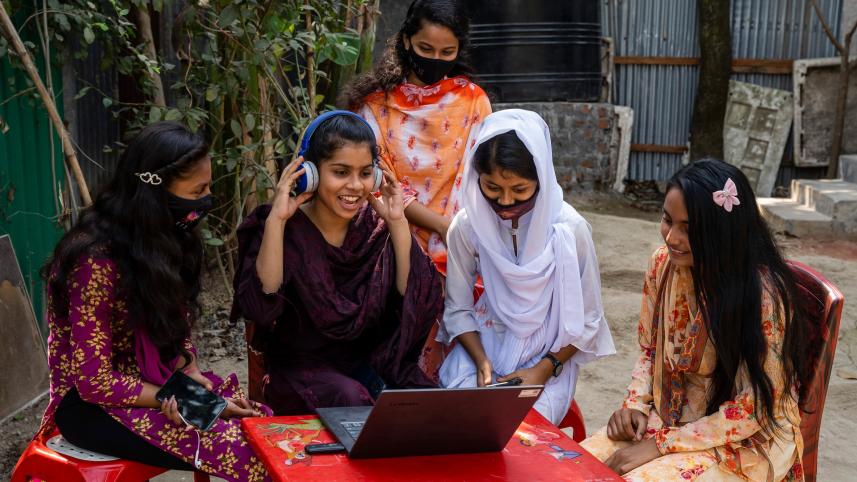
The development paradigm around the world has been emphasising on the issue of integrating women and women empowerment since the "Gender in development" approach has been established and this trend was even more inscribed when SDG (Sustainable Development Goals) came in effect. Women's emancipation and empowerment became the most important prerequisite for ensuring sustainable development. However, despite such all-encompassing approach, many girl children, adolescent girls and women remain in the periphery of human development. When we pan our lens towards Bangladesh, there is no exception. Though Bangladesh is a success story when it comes to girl child education, the loophole remains in the scenario that these girls do not get the opportunity to learn the practical skills that are most valued in any economic sector to reach high-professional and managerial posts and secure a safe life for themselves in the society. It is due to the lack of opportunities to learn English language skills, digital skills and social skills.
British Council found this vacuum spot in the current curriculum in Bangladesh education system which also addresses the fact that to overcome this situation, we must facilitate a programme solely dedicated for the girls.
 For all latest news, follow The Daily Star's Google News channel.
 That is how, the EDGE programme was launched in 2012 to improve girls' education by providing them with English, Social and Digital skills. The exceptional fact about this programme is that it has an extensive safeguarding protocol to ensure a safety net for girls that are enrolled into the programme. Every club consisting of participants from different regions of Bangladesh has focal points who would intervene being aware of or sensing anything unpleasant coming these girls' ways.
Since 2012, EDGE programme has established 364 after-school clubs and undertaken 799 peer group leaders along with 8973 club members. These clubs are the most integral part of the programme, because the fundamental of the project is to address the issues in the participatory approach with upwards direction. The peer group leaders and the club members are girls from underprivileged marginalised communities from different regions across the country. The pilot phase, which was initiated back in September, 2021, was conducted in districts of Bagerhat, Gazipur, Manikganj, Dhaka. Through the partnership with Hong Kong and Shanghai Banking Corporation (HSBC), British Council is implementing the project by the implementing partner Spreeha Foundation Bangladesh and Dnet.
Due to the pandemic, the pilot phase was delivered through virtual platforms, which includes Facebook and other low-tech solutions. Adolescent girls from these regions were admitted into the programme with a view to be provided with the knowledge that would build their capacity, facilitate career counselling, mentorship, language skill development, digital navigation skill and most importantly, how to protect themselves from many social practices that happen against girls; for example — early marriage, bullying, cyber bullying, harassment etc. These lessons are primarily disseminated among peer leaders through elaborate training and later on, circulated among club members by peer group leaders. This model has been especially developed to ensure sustainability.
If we look into the work of economist and development scholar, Amartya Sen and Nancy Fraser, we would see how they emphasised on capacity development in their capability approach of development. According to them, development would only take place if the vulnerability and marginalisation of people can be battled through capacity building. It would make people confident in themselves and fulfil their life purpose.
This ideology is absolutely aligned with the driving spirit of EDGE. It wants to create confidence in girls about themselves and their own capacity. This would be the first step in the ladder to development. Hence the community-based learning system has been a fundamental in the process.
The participant in the programme have come a long way. From helping parents to register for COVID vaccine through website to rescuing a peer from getting married at an early marriage by counselling parents against early marriage; these girls have done it all.
They do have a longer way to go; considering the pandemic situation in Bangladesh, which saw rapidly rising number of dropouts from school and early marriage. The EDGE programme intends to stop this upward trend by instilling awareness within them, as well as their families. The concern of this project also encompasses the parents and aims to create awareness among parents through their children. After the successful completion of the pilot phase, face-to-face EDGE is going to start its journey very soon.
The aim of this project is to push and break the biases of gender and class and ensure that girls can fulfil their potential and be their own people. Today's girls deserve every of bit of this effort.
EDGE project is there to push the boundaries for them and giving them opportunities that these girls very rightfully deserve.