


Eid rush casualties highest in 7 years
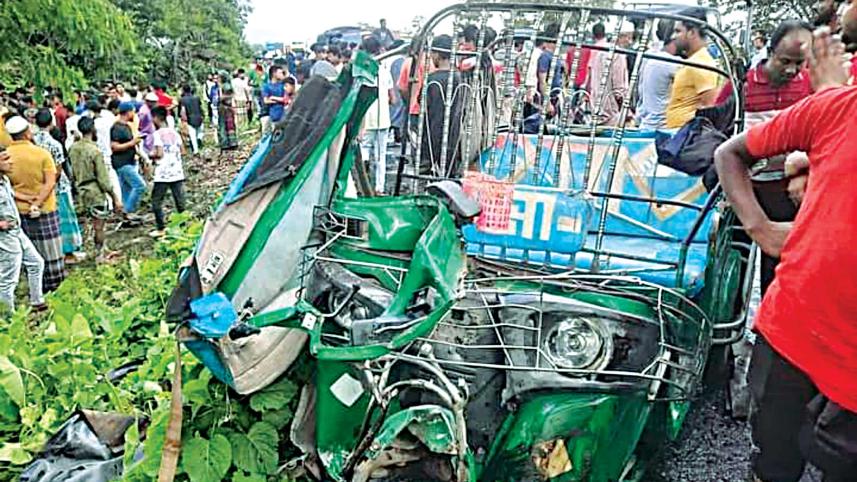
The country has witnessed the highest number of road crashes and deaths during the Eid-ul-Azha rush this year since 2016, exposing the poor state of road safety.
At least 398 people were killed in 319 road crashes in 15 days before and after the Eid. The figures are 46 percent and 33 percent higher respectively compared to the same period last year, according Bangladesh Jatri Kalyan Samity data, prepared based on media reports.
 For all latest news, follow The Daily Star's Google News channel.
 Although motorbikes were banned on highways for seven days during Eid time, they were involved in accidents that resulted in 131 deaths.
"If we compare accident data of the last seven years, the number of both the accidents and the deaths during this Eid rush is the highest," Mozammel Hoque Chowdhury, secretary general of the Samity, said while sharing the report at a press conference at Dhaka Reporters' Unity yesterday.
Prominent economist Hossain Zillur Rahman, also chairman of Safe Road and Transport Alliance, which promotes road safety, said the numbers of accidents and casualties are rising despite various steps by the authorities to reduce them.
"A lack of road safety has turned out to be a human catastrophe for Bangladesh and its severity is increasing, instead of decreasing, over the years," he told the press conference.
With the number of accidents rising, deaths on highways have become a major concern.
Different steps by different authorities have failed to improve road safety and cut death tolls, as police reports show road crashes and deaths rose by 30 percent last year from a year before.
Roads turn highly unsafe during Eid rush as a greater number of vehicles hit the streets to cater to the huge pressure of home-goers, as evidenced in the Jatri Kalyan Samity report.
The actual number of the accidents and deaths may be higher, as the Samity prepares its report based on accidents reported in the media, where many accidents go unreported.
27 PEOPLE KILLED DAILY
Mozammel said around 1.20 crore people left Dhaka ahead of the Eid while around 4 crore people travelled from one district to another during this time.
The government's decision to ban bikes on highways during Eid rush caused scarcity of vehicles, creating an anarchy over fares while many unfit vehicles hit the streets to cope with the demand, Mozammel said.
A range of mismanagements caused traffic congestion on highways, leaving people to suffer for up to 20 hours, he added.
He said at least 398 people were killed in 319 road crashes 15 days from July 3 to 17, which is nearly 27 deaths a day.
During the same period last year, 273 people died in 240 accidents.
Twenty-five people were killed in 25 train-related accidents, and 17 people were killed in 10 waterways accidents, he said.
At least 131 people died and 68 others were injured in 113 accidents involving bikes, which is 35.42 percent of the total accidents and 32.91 percent of the total deaths, he said.
Among the victims, 157 were drivers, 106 pedestrians, 62 women and 51 children.
Of the accidents, 23.19 percent were head-on collisions while pedestrians were crushed to death in 50.78 percent cases. Vehicles fell into ditches in 18.49 percent of cases after losing control, he said.
WHY SO MANY CRASHES
Kazi Md Shifun Newaz, an assistant professor at Accident Research Institute of Buet, said many of the accidents took place on the roads that have no dividers.
The government should build dividers on every road to avoid head-on collisions, he added.
Drivers usually drive vehicles for eight to 10 days before Eid without any rest. This leads to reckless driving, resulting in crashes, he said, adding that the authorities should develop a roaster system for drivers to avoid the situation.
Referring to the large number of deaths of pedestrians, he said a lack of safe crossings as well as markets, schools and colleges along roads are major reasons.
Hossain Zillur, also former adviser to a caretaker government, blamed nonchalance of authorities for the situation.
The authorities are taking what he called some "partial steps" to reduce road crashes which are often limited to taking initiatives. "But we want to see results."
Road transport sector is a very important sector, which is seeing an imbalanced expansion, he noted.
He said bikes and easy-bikes, considered major contributors of accidents, are increasing due to a lack of public transport, he added.
The economist said "vested interests" get priority in the transport sector with political blessings with little regard for public interest.
He recommended taking steps against political favouritism to change the situation.
According to him, road accidents cannot be reduced without solving the overall problems that the transport sector faces.