


Australia–Bangladesh: A booster dose for trade diversity?
Within Australia, Bangladesh is perceived as an aid-dependent, impoverished country which is subjected repeatedly to natural and human-induced disasters like cyclones, floods, and building collapses due to poor building standards. In reality, however, the country has made impressive strides in its development journey, and that image is in need of a refresher.
Bangladesh recorded nearly six percent annual GDP growth from 2000-2019 and officially registered a 3.5 percent growth rate in the Covid-19-ravaged 2020, raising the country's GDP to almost USD 320 billion. In 2019, prior to Covid-19, the economy grew by eight percent. A GDP per capita of around USD 2,000—for a population of around 160 million—means that the country is set to graduate from the Least Developed Country (LDC) status in the next few years.
 For all latest news, follow The Daily Star's Google News channel.
 Indeed, Bangladesh could be described as the least known, fastest growing economy in Asia. A few months ago, it was reported that the country had overtaken India in terms of per capita income, and recently it even provided foreign exchange assistance to Sri Lanka. In terms of recent growth rates and the size of its economy, Bangladesh has many similarities with Vietnam, a country which receives a lot more attention in Australia.
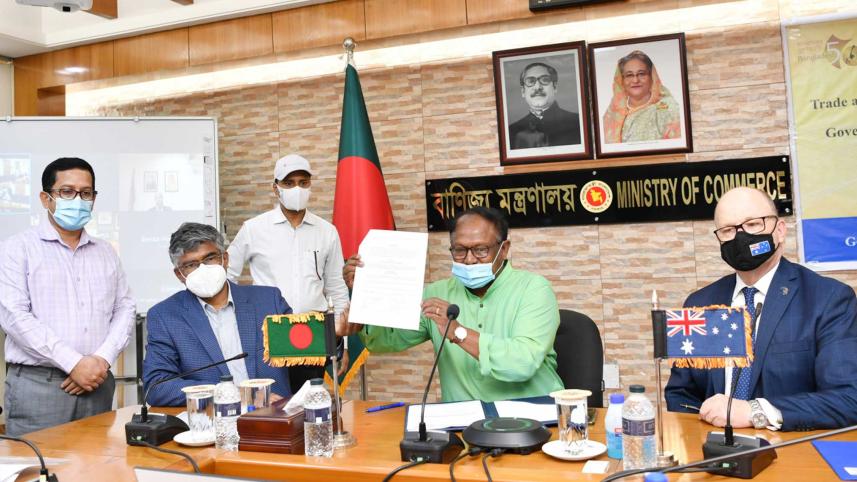
The conclusion of the Australia-Bangladesh Trade and Investment Framework Arrangement (TIFA) on September 15, 2021 is, therefore, timely and could provide the necessary boost towards a more significant economic relationship. While TIFAs are seen as mostly symbolic and replete with good intentions, they do signal an injection of commitment and ambition. TIFAs do not guarantee trade and investment growth, but there are examples where instruments like TIFAs have presaged the building of more expansive economic ties between countries. An example is the US-Bangladesh Trade and Investment Cooperation Forum agreement, which was signed in 2013; by 2019, bilateral trade in goods between the two countries had increased by close to 50 percent. In this specific case, the TIFA also highlights that Australia's scope for opportunities in South Asia goes beyond India.
The current bilateral trade relationship is modest. The Department of Foreign Affairs and Trade's latest figures show that Bangladesh is Australia's 30th largest partner, with two-way trade amounting to about USD 2 billion. Almost half of that relates to Australian imports of textiles and clothing and exports of cotton. Starting from that low base and combined with Bangladesh's good prospects for a post-Covid recovery, there should be room for growth. Bangladesh's large, young, increasingly urbanised population and a growing middle class should interest a range of Australian exporters and investors.
One substantial opportunity is liquefied natural gas (LNG). Bangladesh's supply of inexpensive domestic gas contributed to its development success. As this depleted, Bangladesh quickly turned to LNG imports, starting in mid-2018 and growing to four million tonnes per annum in 2020. Forecasters are expecting LNG imports to grow to 20 million tonnes per annum by 2030—a fivefold increase in less than a decade.
Australia was the world's largest LNG exporter in 2020, just ahead of Qatar. Australia's LNG production facilities in the north of the country are among the closest to Bangladesh's already functioning and planned LNG import facilities. On paper, Australia should be able to be a competitive supplier to the country due to lower shipping costs.
To date, Bangladesh's long-term LNG contracts have been concluded under the so-called "government-to-government" arrangements, namely with Qatar and Oman. The TIFA could provide an avenue, through which the prospects for a sustained LNG trading relationship could be developed, including by the two governments, ensuring that Australian LNG producers are able to compete on an equal footing.
For this to occur, Australian LNG producers, and indeed suppliers of other commodities, will also need to be convinced of the value of trade diversification and take more innovative approaches. Learning to deal with new customers in Bangladesh will require patience and creativity.
Australian producers have traditionally enjoyed the custom of buyers from Northeast Asia (Japan, China, Korea, and Taiwan), who have consistently been prepared to provide attractive terms. While price is part of the equation, another part is these customers' good creditworthiness and preparedness to share risks and obligations. To get the necessary comfort with dealing with buyers with less experience and lower credit ratings, Australian producers will need to consider ways to manage the perceived higher risks or, indeed, by developing an appetite for higher risk, as sellers from other countries have done to develop new markets like Bangladesh.
It will also require Australian producers to have a long-term commitment to acquire a sophisticated understanding of the country and tot enduring relationships. This is easier said than done as Australian companies can be expected to focus their efforts on markets that promise the best returns. Their willingness to do things differently in Bangladesh will likely depend on their perceptions of whether they can continue to count on Northeast Asia as the market of choice.
Bangladesh's success has attracted many other partners, and the landscape is competitive. The Australian government, through Export Finance Australia and Austrade, should consider some of the policies other countries have already used to develop market share in Bangladesh in order to expand Australia's presence.
While it does have significant structural issues to address, many observers are cautiously optimistic that Bangladesh will be able to move up the manufacturing value chain. Australia is well-placed to supply the country with natural resources and value-added inputs, as it has done elsewhere in the region as countries industrialised. Australia is also well-suited to provide a greater range and level of services, as has been done in the education sector where Australia has an established brand name in the country.
Bangladesh understands the need to both attract new investment and diversify its economy in order to lessen its dependence on the ready-made garment sector, remittances from its large diaspora, and some light manufacturing. The country has been increasingly active in looking at how it can attract the necessary investment, both to help in this diversification push and to modernise its infrastructure. Australian investors, especially those with an appetite for—and experience in—investing in Asian infrastructure, should take note.
Australia's ever-growing challenges with China have led political leaders to stress the need for more trade diversity. Bangladesh should feature strongly in the list of countries which can potentially provide that additional bandwidth. The two countries share historically significant relations: Australia was the fourth country to recognise Bangladesh's independence in 1971 and has been a committed development partner. People-to-people links are considerable, with over 40,000 people born in Bangladesh calling Australia home, according to the 2016 census. The English language and cricket provide good cultural commonalities.
Both countries are also wary of being dominated by larger and more assertive neighbours. And Bangladesh is rising in prominence as a potential partner on strategic issues in the region. While there are some tensions between Bangladesh and India, the relationship is sturdy, and increased cooperation between Bangladesh and Australia in this area is unlikely to draw ire from Quad partner India.
The TIFA is a signpost that, in the fast-evolving geopolitical and geoeconomic environment, Australia and Bangladesh do have many genuine interests in common, and they can and should work much closer together. At the end of the day, however, unless the business communities and political leadership of both the countries seize the opportunity, the TIFA will end up being symbolic and left on the shelf of unmet expectations.
Brendan Augustin has worked in the Department of Foreign Affairs and Trade (DFAT) in Australia. He has also worked in senior roles in Oil, Gas, and Mining. He is now the managing director of Bina Group.
This article has been republished under a Creative Commons Licence.