


The empty bed: Fighting Covid-19 from an ICU
Nothing had prepared us for this.
I enter the transition zone to the Intensive Care Unit (ICU) of the British hospital I work in. "Here we go again", I think to myself. A Health Care Assistant (HCA) kindly offers to help me put on my full protective gear. It's heavy and suffocating. But it's there for a reason. Thanking her, I enter the ICU, putting on a brave face.
 For all latest news, follow The Daily Star's Google News channel.
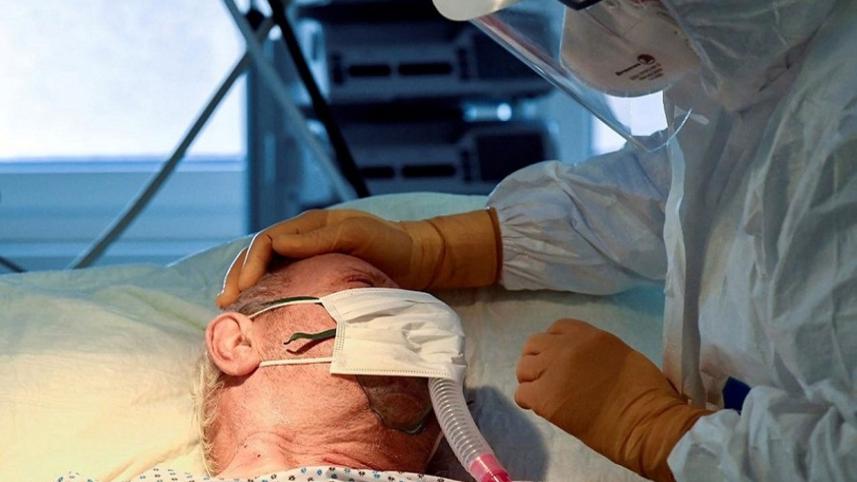
 You must have a brave face. Because you are fighting the odds in here. You leave all your worries, fatigue and fear outside. It's a completely different picture inside. Bed after bed and ward after ward of patients in every direction. Doctors, nurses, HCAs, physiotherapists, pharmacists and even medical students can be seen running around, doing their part. Each patient is holding on for their lives with the help of ventilators and other artificial support. Screens bleep away with their various organ parameters. This is their last line of hope. Only when all methods have failed, do they end up here.
Thus, the stakes multiply exponentially. And as bitter as it may sound, not all of them come back from it. When the team comes to the difficult realisation that all the artificial support being provided to an individual won't bring him/her back, the dreaded call goes out. We speak to the family on the phone. We try bringing them to the hospital for one last encounter with their loved ones. This is the worst part of it all. Watching helplessly as the family surround their loved ones, one last time. The sorrow, the bitterness, the sense of disbelief in their eyes. No matter how many times you witness this, it never gets any easier.
You think of your near and dear ones. You think of life. It could easily be you in their place. Fate is the only thing preventing it. Some families are not lucky enough to say their final goodbyes. We had a gentleman who passed away two minutes before the family reached. The sight of the grieving widow, beating on the chest of her deceased husband in her sorrow, was not for the faint-hearted. Stories like these build up as we advance further and further into this dystopia.
The National Health Service (NHS) of the UK prides itself in being one of the best health services in the world. But even the NHS has been stretched thin and pushed to its limit. An ICU should usually have a 1:1 ratio staffing. That has been stretched to 1:4 in most, in some instances even more than that. Clinical staff from all specialities (including myself) have been brought in to cope with the influx of Covid-19 patients taking a turn for the worst. No work is deemed unsuitable for anyone. We have senior consultants helping to clean the patients. You have second and third year medical students trying their best to help the amazing ICU nurses.
The alarming number of Bangladeshis I have seen in this short time ending up in ICU has left me with a heavy heart. Seeing so many of your own kinsmen suffer the lethal blow from this virus leaves you scarred. Seeing so many beautiful people taken away from their families before their time leaves you wounded. The number of ICU beds in our hospital have increased three fold, with elective theatres shut to make space for more ICU beds. This is a similar theme throughout most hospitals.
An empty bed tells an all too familiar story. An individual who has lost the battle with Covid-19. But the bed won't remain empty for too long. For soon enough, another victim of this ruthless virus will be its occupier. For how long? Impossible to tell. But you can bet we will do everything in our capacity to help him/her win this battle. We will keep on fighting till the empty bed remains empty. Scars, wounds and a heavy heart have to take a back seat for now.
Like I mentioned in the beginning. Nothing had prepared us for this.
Dr Sabereen Huq is a junior doctor working at University College London Hospital, London, UK. He graduated from Mymensingh Medical College, Bangladesh.