


Less crop land, less food
Nearly 80 percent of Bangladeshis live in the rural areas and more than 66 percent of them are engaged in agricultural activities. More than three-fourth of the country's total crop land are devoted for cereal food production. In such a subsistence-oriented agrarian economy domestic food production plays vital role in food security.
Over the last few decades, production of food grains have increased tremendously but there is still a need to increase cereal (especially rice) production to meet the increasing food demand for a growing population. In a country where cultivable land is becoming so scarce, it is important to increase the productivity of land to grow more grains. Even though the food grain sector has shown remarkable growth performance the reality is that with around two million people being added each year, this has barely made a dent towards improving the food security condition.
 For all latest news, follow The Daily Star's Google News channel.
 In Bangladesh the growth in food grain production during the last few decades originated from the expansion of area under high yielding varieties of rice and wheat developed by the concerned research institutes. In fact, the key to meeting the challenge of sustainable food security is to devote more areas under the available high yielding modern rice genotypes to achieve higher productivity. In order to feed the growing population, cereal food production must increase by 0.45 million tons per annum.
The existing land use scenario indicates that more than three-fourth of the rice cropped area is devoted to cultivating the available high yielding modern rice varieties based on the land suitability. The remaining areas are considered to be unsuitable for modern rice technologies because of the prevalence of various abiotic constraints (e.g. salinity, drought, submergence, early flash flood etc).
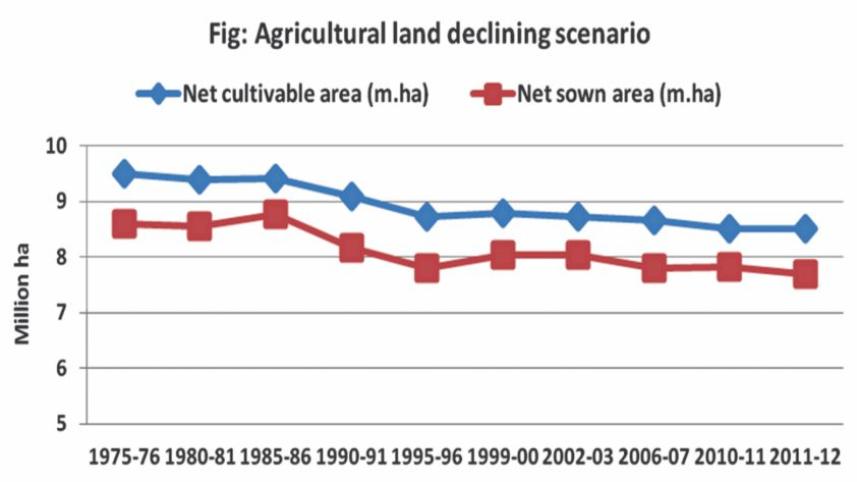
Almost two-thirds of the country's total landmass of 14.4 million hectares has been brought under cultivation. According to official statistics the net cultivated/sown area in Bangladesh during the eighties ranged within 8.56 and 8.22 million hectares. Over the last decades, the cultivated land has declined perpetually (dropping to 7.8 m. ha in 2011/12) due to housing, industrialisation, infrastructure and commercial development.
The growth of rural settlement however, is considered to be the main driver of the land lost from crop agriculture followed by urbanisation and industrialisation. In fact, housing to accommodate the ever increasing population in Bangladesh is expanding towards agricultural land. A recent FAO commissioned study revealed that agricultural land availability declined at 0.18 percent annually during the period 1976-2000, and the declining trend accelerated sharply after 2000, recording a decline of 0.45 percent annually during the period 2000-2010. This indicates that a sharp change is taking place in the trend of shifting land from crop agriculture towards settlement, infrastructure and commercial development. The consequence is a continuous reduction of crop land and hence much needed food grains production.
The shrinking trend in land availability for crop production is a serious challenge ahead of the economy. For a developing country like Bangladesh, self sufficiency has been and will remain as key focus in food production strategy in order to meet food deficiency. Since food security is the main concern of the government, necessary steps should be taken to protect agricultural land from shifting to non-agricultural uses. In sustaining the growth of domestic food production in line with the needs of a growing population, it is indeed time for the policy makers taking step to impose regulations to stop the consistent decline of crop land.
The writer is the former Chief Economist and Head of Agricultural Economics Division of BRRI, Gazipur and former National Economic Advisor of the Dhaka based Food and Agriculture Organization (FAO) of the United Nations.
Email: msalam_07@yahoo.com