


On Srebrenica twenty years later
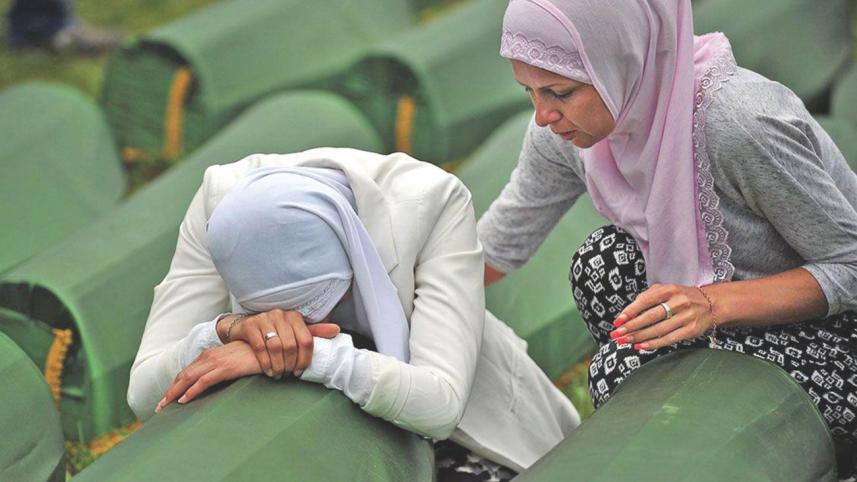
Twenty years have passed since that horrific day of July 11, 1995 in Bosnia and Herzegovina, when Army units of the self-proclaimed Republic of Srpska, led by the infamous general Ratko Mladić, entered the town of Srebrenica. What followed is well-known globally, even though the true scope and the very essence of this event have been too many times, and in all possible ways, challenged or minimised.
One thing is, however, indisputable. Disregarding the question of whether the UN Security Council (too often prone to double or even multiple standards) will – or even should – ever adopt the Srebrenica Resolution, the fact remains that the biggest massacre in Europe after the Second World War was committed there by the Bosnian-Serb forces who in five days of carnage managed to kill more than 8,000 men – all of them Bosniaks – ranging from 12 to 77 years.
 For all latest news, follow The Daily Star's Google News channel.
 There is not a trace of doubt that what took place in the town which was one of six "safe areas" under protection of Unprofor was ethnic cleansing in its most horrific version. Mass-murder done by Mladić and his military commanders, taken together with cowardly behaviour of the contingent of Dutch peacekeeping troops, represents a textbook example of how this combination of extreme brutality of conquerors juxtaposed with miserable indecision of those who were delegated to save lives but chose to do nothing instead, results in a bloodshed of gigantic proportions.
Committing a genocide – that goes without saying – is not for the faint-hearted. It is, however, worth noting that the one in Srebrenica was executed with admirable precision and discretion, proving that the perpetrators were fully aware of the criminal nature of their deeds as well as of the possible consequences. Nowadays, Mladić is in the Hague awaiting verdict for genocide, together with a number of his former henchmen. The same goes for the civilian leader of Bosnian Serbs – Radovan Karadžić. The slowness and inefficiency of the International Court of Justice in the Hague is, however, notorious. Slobodan Milošević died in prison before the verdict was reached. Serbian ultra-right politician Vojislav Šešelj kept turning the courtroom into a circus for years before he was finally and shockingly ordered to return to Serbia and to wait for his verdict there.
But the military and civilian leaders of Bosnian Serbs were not acting alone, of course. It was 1995, and after three years of bloody war, peace was the order of the day in Bosnia and Herzegovina. It was meant to happen as soon as possible and no price then seemed high enough for our global leaders. And so, the UN and the EU and the Contact Group of five nations decided to finally "understand" the realities of the Bosnian war. They accepted Serbian president Milošević – previously known as the "Balkan butcher" – in his new role of the "peacemaker". They also nodded to the Bosnian Serb military resolution to finally round up their scheme by taking over Srebrenica and incorporating eastern Bosnian enclaves into their statelet, called the Republic of Srpska, constructed on the sticky foundation of sheer human misery.
So it is no wonder that some of them later tried their best to diminish the dimensions of the crime committed. For instance, the special UN envoy Carl Bildt insisted in his memoirs that "in five days of massacres, Mladić had arranged for the methodical execution of more than three thousand men... And probably more than four thousand people had lost their lives in a week of brutal ambushes and fighting..." thus cutting the number of innocent victims by half through presenting them as the terrible but – alas – unavoidable human loss of war.
Even today, we cannot reconstruct the last moments of lives of the huge majority of those who perished. We can only imagine the horror they had to go through. However, Bosnian journalist Dženana Halimović kept painstakingly collecting their photographs; so far she managed to collect more than 2,400. She "wanted to ensure that the victims – and not just the names – are remembered" to which end she recently posted this heart-wrenching collection online (http://www.rferl.org/fullinfographics/infographics/27114531.html).
Several years ago a certain video-tape surfaced in Serbia. At least for a short while it left the whole public in a state of shock and paralysis. It belonged to the members of the notorious Serbian paramilitary unit called Škorpioni (Scorpios) and contains footage of the execution of six Bosniaks (the youngest among them was only 16 years old) in the vicinity of Trnovo, 180 kilometers away from Srebrenica.
This video, more than anything we saw before, gave us a morbid insight into the very mechanism of the genocide. We could watch in stomach-churning detail the humiliation, suffering and pain that the victims had to go through before their inevitable death.
We could also see that the executioners clearly enjoyed what they were doing. And the fact that the video-tape remained undiscovered for years after the crime was committed, while it was available all this time to those who knew what to ask for under the counter of the local video-club, sheds special light on the whole endeavour. It accentuates a specific snuff quality of that recording which seemed to have actually suited the (erotic?) taste or at least morbid curiosity of its viewers, together with the sociopathic lack of remorse of those who so gleefully committed the hideous crime and recorded it for the whole world to see.
Despite all hard evidence, for the revisionists and sceptics among us, nothing ever amounted to the proof undeniable enough for them to finally take in what they, out of certain emotional reasons, are not ready to accept. Faced with facts and reason, many people here in Serbia still reply with "counter-argumentation" compiled of false truths ("But what did they do to us?"), easy handed justifications ("It was a war and in wars people get killed!") paranoid illusions ("None of it would've happened if it wasn't for the Western conspiracy against the Serbs!"), persecution mania combined with the grandeur complex ("Everybody hates us and we had to protect what's ours!"). Or, alternatively, they – just like the above mentioned Carl Bildt – immediately switch to their favourite game of numbers. Apparently, "there weren't eight thousand victims in Srebrenica, no, not at all, but hardly three thousand, and everybody knows that the three thousand people murdered on spot is not a genocide but a light massacre at best".
In such situations, there is nothing left for a man to do but to give up arguing and quietly retreat, exhausted and depressed.
And still, what was done on behalf of the Serbs during those hot and horrific July days of 1995 cannot simply be retreated. Srebrenica, to put it shortly, has nowhere to go. Our society will have to learn to accept it, sooner or later, fully and responsibly. The fact that the highest ranking politicians in the country nowadays claim that they will visit the town on the twentieth anniversary of the mass-murder (only if the security measures allow them to, of course!), while at the same time carefully avoiding the words "massacre" and "genocide", actually changes nothing at all. Srebrenica, therefore, still remains with us to haunt us. It is always close to heart and mind and serves to constantly remind us just how deep and dark our most horrific abysses are. It is a living proof of the shame of those among us who proved just how industrious and successful they were capable of being when it came to committing such mind-blowing atrocities – simply the best, exactly when they were at their very worst.
The writer is a Serbian novelist, columnist, translator, editor, musician, and publisher. He lives and works in Belgrade.