


Why we should make farming more market-oriented
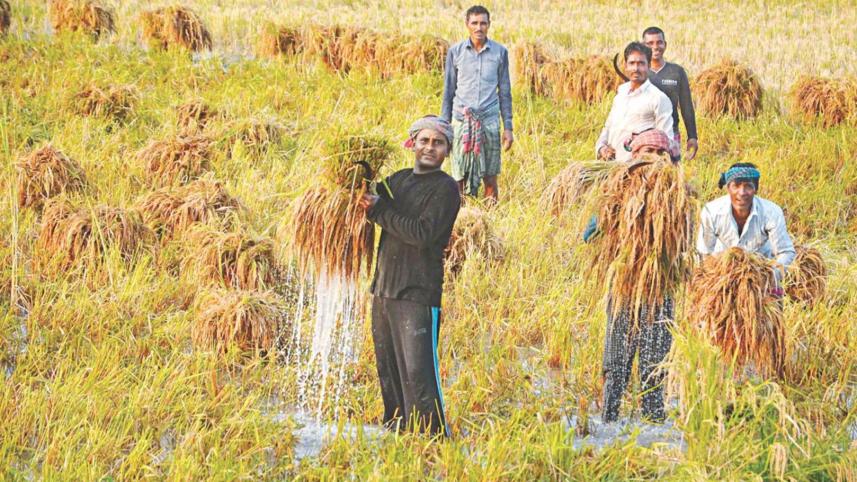
One of the most serious challenges of the Covid-19 pandemic is the threat to agriculture and therefore to food security. So far, the government has been able to ensure a steady supply of essential food items like vegetables, fruits, fish, meat and so on across the country. But in the near future, sustainability of food production and supply might be hampered because of the continued containment measures adopted to fight Covid-19 that restrict free movement of labourers and allow limited access to the market.
In spite of the ongoing health crisis, Bangladesh has made it possible to achieve a record "Boro dhan" production (204.36 lakh tons) and expects to have 31.13 lakh tones of "Aus dhan" and 163.08 lakh tones of "Aman dhan", as targeted for 2019-20. Besides, production of wheat, maize, potato and other crops also increased compared to previous years. As per the data of the Export Promotion Bureau (EPB), Bangladesh earned about USD 9 crores and 96 lakhs during 2018-19 by exporting vegetables. During the first nine months (July to March) of 2019-20, export earnings of vegetables increased by 80 percent and it reached USD 14 crores and 67 lakhs. During the Covid-19 pandemic, the prime minister has categorically stressed that crops have to be grown on every inch of land to fill the nation's food basket. The exclusive and timely allocation of Tk 200 crores for purchase of farm machinery like combined harvester, ripper, power tiller, power thresher, etc. paved the way to achieve 100 percent harvesting target of "Boro dhan". Besides, an amount of Tk 9,500 crores has been allocated for fertiliser and agricultural mechanisation in the proposed budget for FY 2020-21 to benefit the farm sector.
 For all latest news, follow The Daily Star's Google News channel.
 Bangladesh has emerged as not only self-sufficient in food production, but also created its image as a food surplus country to the rest of the world. It is hoped that agriculture will become a great platform for supporting the livelihood of people amidst the coronavirus-induced crisis in industrial and service sectors. In order to elevate the agriculture sector to commercial scale, and to increase Bangladesh's capacities to deliver commodities at the global market, there is an immediate need for an in-depth analysis of our priorities and policies.
Agriculture is the engine of the nation's economy and around 41 percent of the population are engaged in this sector—with a growth rate of 3.7 percent every year—although cultivable land is declining by 0.73 percent per year. Agriculture shares about 14 percent of Bangladesh's national GDP.
Bangladesh is fortunate because 60 percent of its total land is cultivable and occupies top position among the Asian nations in that regard, but the contribution of agriculture in its national GDP is a mere USD 41 billion. In terms of agriculture's contribution towards national GDP, other frontrunner countries are India (USD 397 billion), Indonesia (USD 133 billion), Pakistan, Thailand and Vietnam. It is noteworthy that Indonesia's agriculture sector contributes significantly to the nation's GDP despite its having a mere 13 percent of cultivable land. A comparative analysis clearly indicates that the volume of agriculture GDP is three times higher in Indonesia than in Bangladesh despite an equal (%) share to the overall GDP. On the other hand, the volume of agriculture GDP of Thailand is equal to Bangladesh, even though the former shares only 8 percent of national GDP.
In view of the above scenarios, the question is, how is Bangladesh lagging behind several countries on the volume of GDP despite its having more areas of cultivable land? If we look at the export figures of Bangladesh during 2018-19, total export was USD 40.5 billion. Out of this, readymade garments contributed USD 34 billion, almost 84 percent of the total export earnings. The export earnings by agriculture were only USD 2.2 billion.
So how can we enhance the agriculture sector's contribution to GDP? Needless to say, Bangladesh agriculture is self-sufficient today in spite of several challenges. The majority of the farmers are unable to undertake "Good Agricultural Practices (GAP)" due to inadequate knowledge and resources as regards usage of advanced farm machinery, storage and quality control measures, and further processing to produce value-added products. In this endeavour, the country's agriculture sector should move towards "safe food production" followed by "value addition" to make it export-oriented.
Farm mechanisation is one of the important elements of modern agriculture that ensures timeliness of farm operations and increases work output per unit area, and has direct impacts on land productivity and farm income. On the other hand, agricultural processing has multiple benefits such as increasing GDP through the addition of goods and new processed products; providing income and employment in rural areas (because of their strong backward linkages); creating a source of exports and foreign exchange; and stimulating agricultural production by creating new stable intermediate markets for raw agricultural products, and assisting producers to improve their farming know-how in some processing activities through vertical integration and production contracts with processors.
There are many ways through which Bangladesh can make a transition from subsistence agriculture to market-oriented agriculture. A private-sector friendly policy can be framed to reduce the regulatory burden on the production of farm inputs such as seed, fertiliser, pesticides, farm machinery, etc.—which will attract potential investors. Environmental sustainability of agricultural production can be strengthened. The quality of public agricultural programmes can be improved and allocations to more effective programmes can be increased. The government can set up a number of large-scale agricultural and food processing hubs across the country through the Agro-Processing Accelerator, a one-stop shop for agro-processors targeting both domestic and export markets involving more private entrepreneurs. Small and medium-sized storage facilities can be established—combined with adopting the best practices in post-harvest handling and storage—to improve food safety, extend the shelf life of produce, and reduce farm losses and post-harvest waste. Last but not the least, a Central Institute of Agricultural Engineering (CIAE), for continuation of R&D with support from the government and development partners, can be initiated.
Dr SM Bokhtiar is Executive Chairman, Bangladesh Agricultural Research Council.
Email: ec-barc@barc.gov.bd